

 macOS
 Windows
 Linux
 Android
 Chrome extension
 Slack app


Tools Operations already uses.
The inbox, the sheets and the project tools already on the floor.


The visit, the count, and what’s still short a document.
Friday’s floor visit, two bins the count disagrees on, yesterday’s inbound walked from the dock notes. Each line carries the note it used.
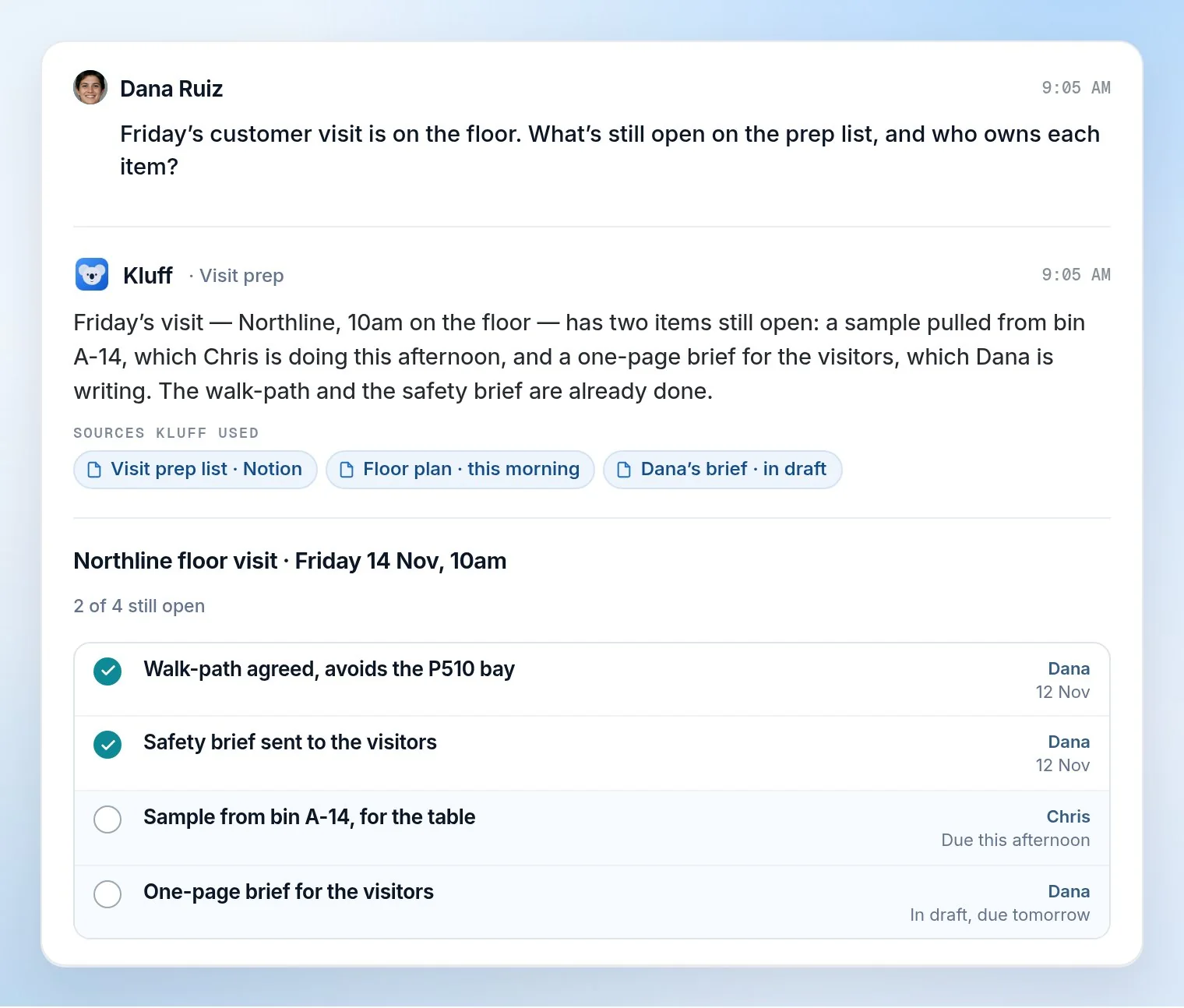
Friday’s customer visit is on the floor. What’s still open on the prep list, and who owns each item?
The walk-path and the safety brief are done. Still open: a sample from bin A-14 (Chris, this afternoon) and a one-page brief for the visitors, which Dana is writing.
Answered from the visit prep list, this morning’s floor plan, and Dana’s draft brief.
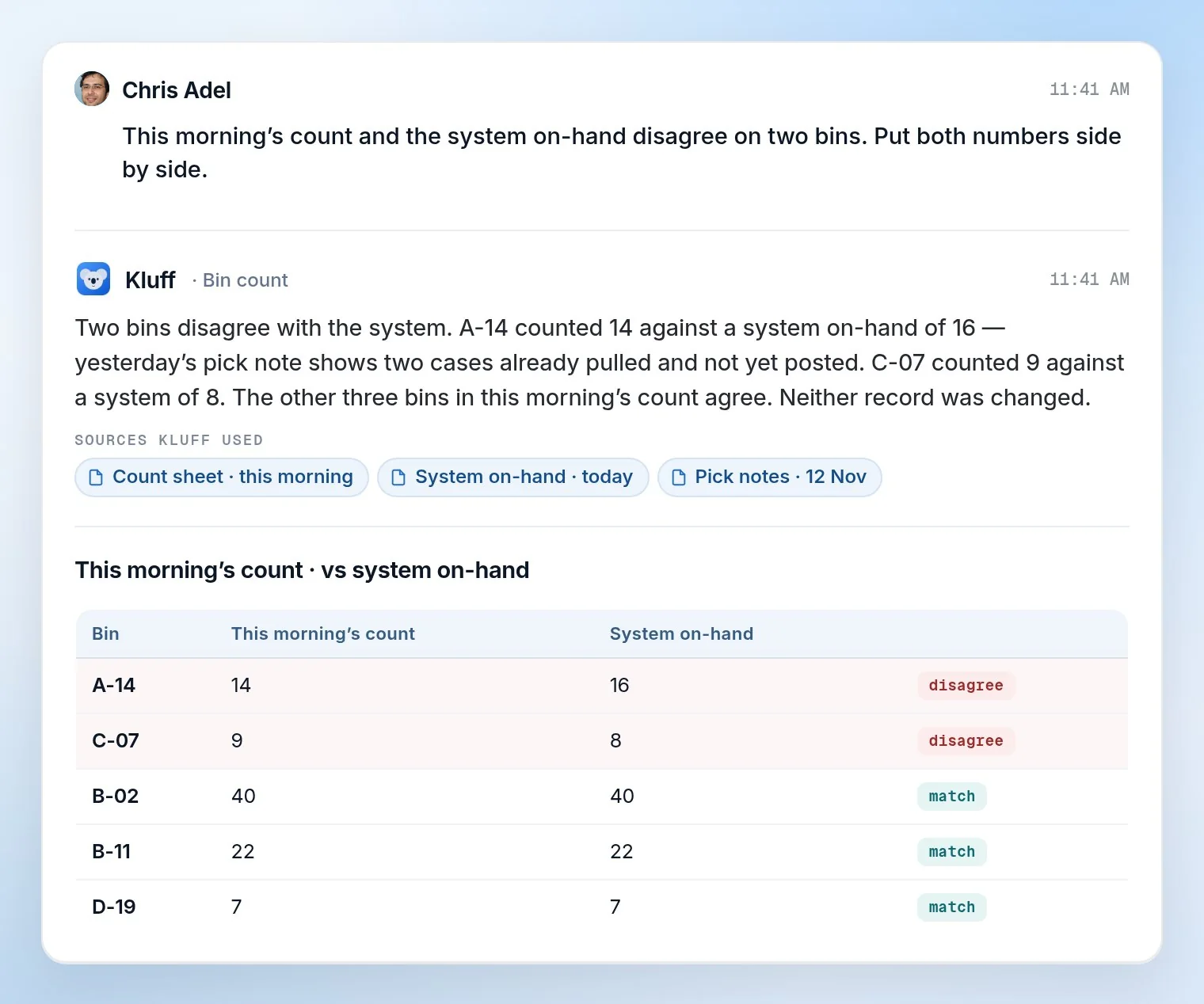
This morning’s count and the system on-hand disagree on two bins. Put both numbers side by side.
A-14 is short two against the system; C-07 is over by one. The other counted bins agree. Both numbers are on the table, with this morning’s count sheet attached.
Answered from this morning’s count sheet, the system on-hand, and yesterday’s pick notes.
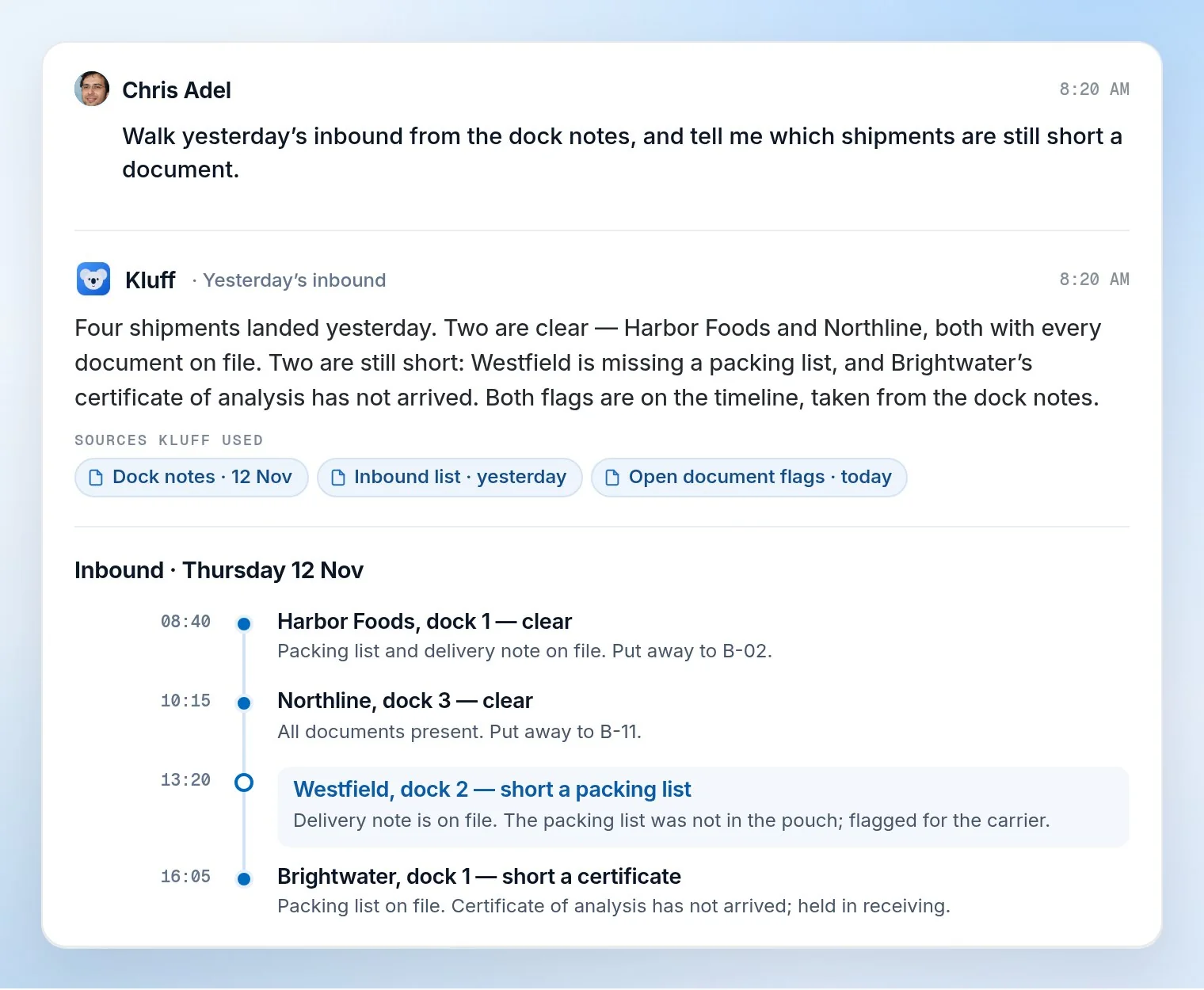
Walk yesterday’s inbound from the dock notes, and tell me which shipments are still short a document.
Four shipments landed yesterday. Two are clear. Two are still short a document: Westfield is missing a packing list, and Brightwater’s certificate of analysis has not arrived.
Answered from yesterday’s dock notes, the inbound list, and the open-document flags.
What Kluff knows about your operations team
Shifts, stock, open promises and the tools already on the floor — one record a handover and a reorder can both use.

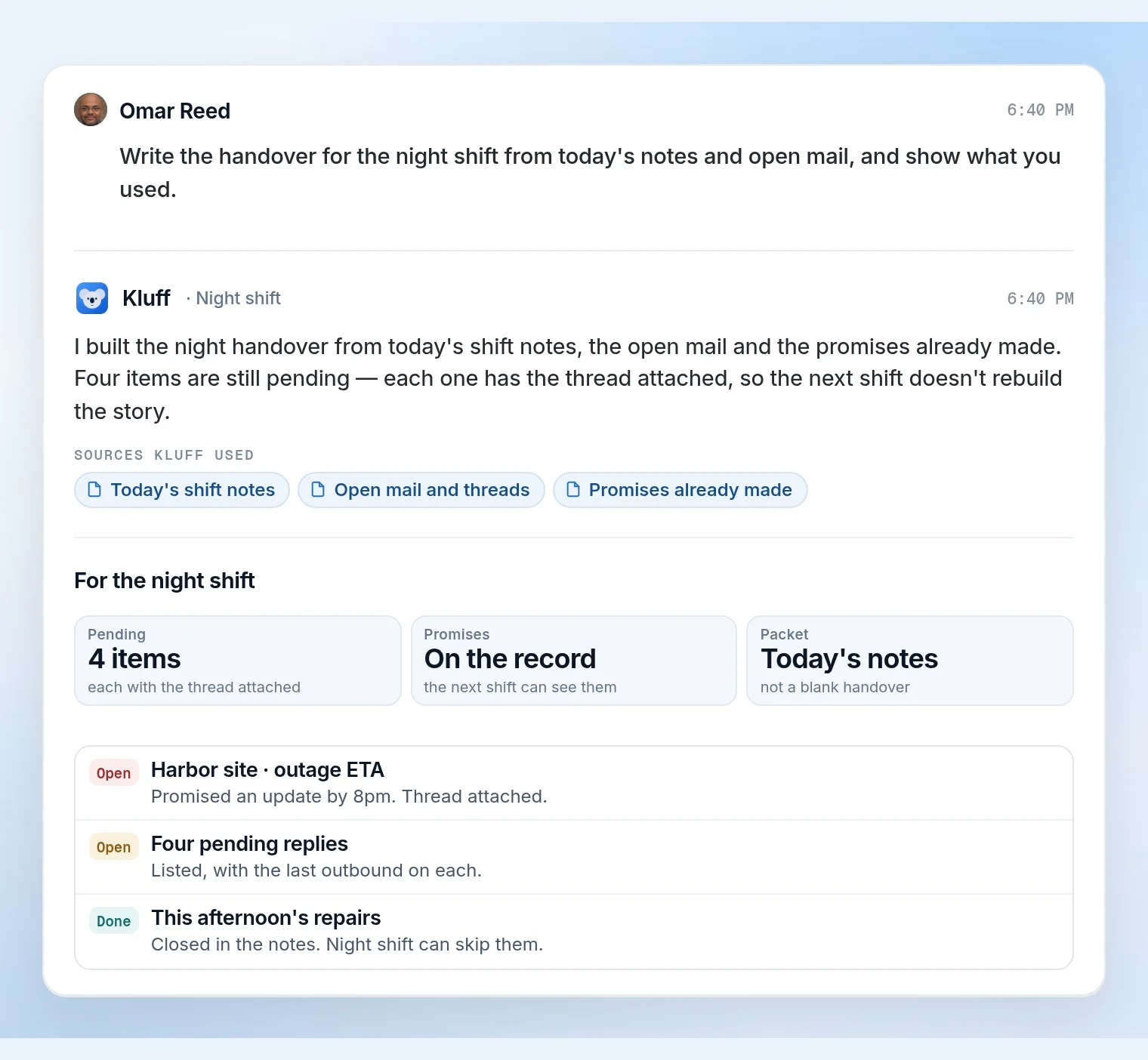
Write the handover for the night shift from today's notes and open mail, and show what you used.
AI agents for business operations
AI operations agents use business records, instructions and connected tools to complete operational tasks. Kluff agents can prepare handovers, summarize blockers and compare stock or project information. Their output depends on the records and tool access supplied for the workflow.
Operations agents can gather status updates, prepare handovers, check outstanding work and coordinate information across systems. Kluff can use project discussions, documents and connected records to produce a working summary, with the relevant context available for the team to review.
Kluff agents can compare available stock records with order priorities to propose allocations and identify shortages. They can also help review reorder points when operational conditions change. Teams should check inventory freshness and business constraints before acting on a recommendation.
Yes. Kluff agents can draft a shift handover from notes, open messages and operational records. A useful handover identifies unresolved issues, owners and promises already made. The outgoing team can review the draft and fill gaps before the next shift relies on it.
Agents can use an SOP as task instructions when it is supplied as accessible context. In Kluff, teams can also capture repeatable instructions in shared skills or define steps in a flow. Procedures should specify inputs, exceptions and the points that need a person’s decision.
Kluff agents can review project conversations, checklists and connected records to summarize blockers and the owners named in those sources. When ownership or status is unclear, the answer can identify the gap for the team to resolve instead of treating an assumption as a confirmed assignment.
Kluff agents can combine accessible project files with data from connected tools. For an operations review, that could mean comparing a stock sheet, supplier correspondence and a task list. Which records the agent can read or update depends on the available connections and their supported actions.
Rule-based workflows execute defined steps when conditions are met. AI agents can interpret requests and use context to plan the work. Kluff supports flows for explicit processes and agent tasks for work such as interpreting notes, explaining an exception or preparing a handover.
Kluff supports recurring agent prompts and scheduled flows. An operations team can schedule a repeatable review when the required data and connections are available. Define what the run should check, where the result belongs and how the team will handle missing information or exceptions.
Start with a bounded task whose inputs and output are easy to check, such as a daily handover or an open-blocker report. In Kluff, provide the relevant records and instructions, review the result and refine the process before adding actions that change operational systems.